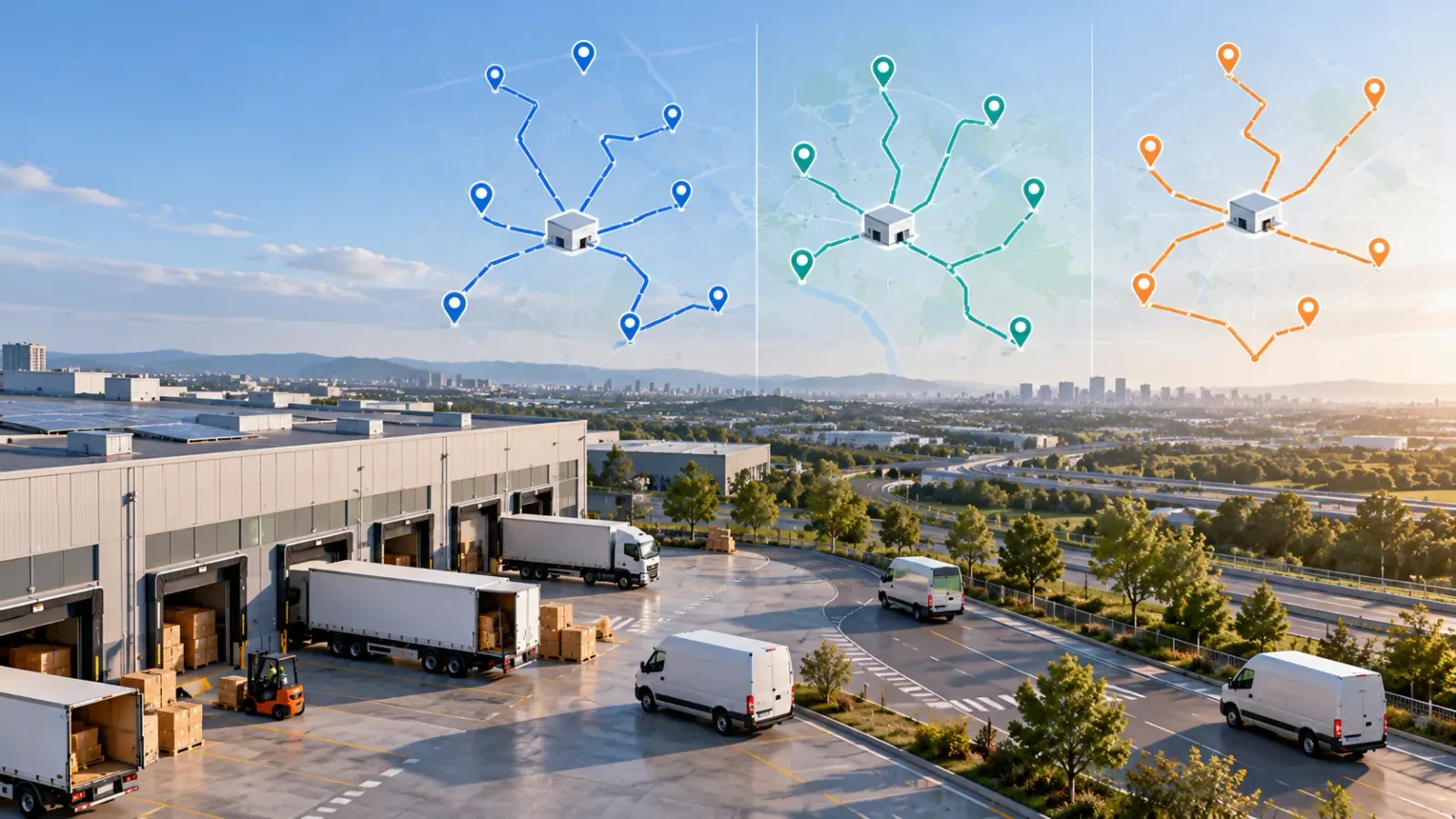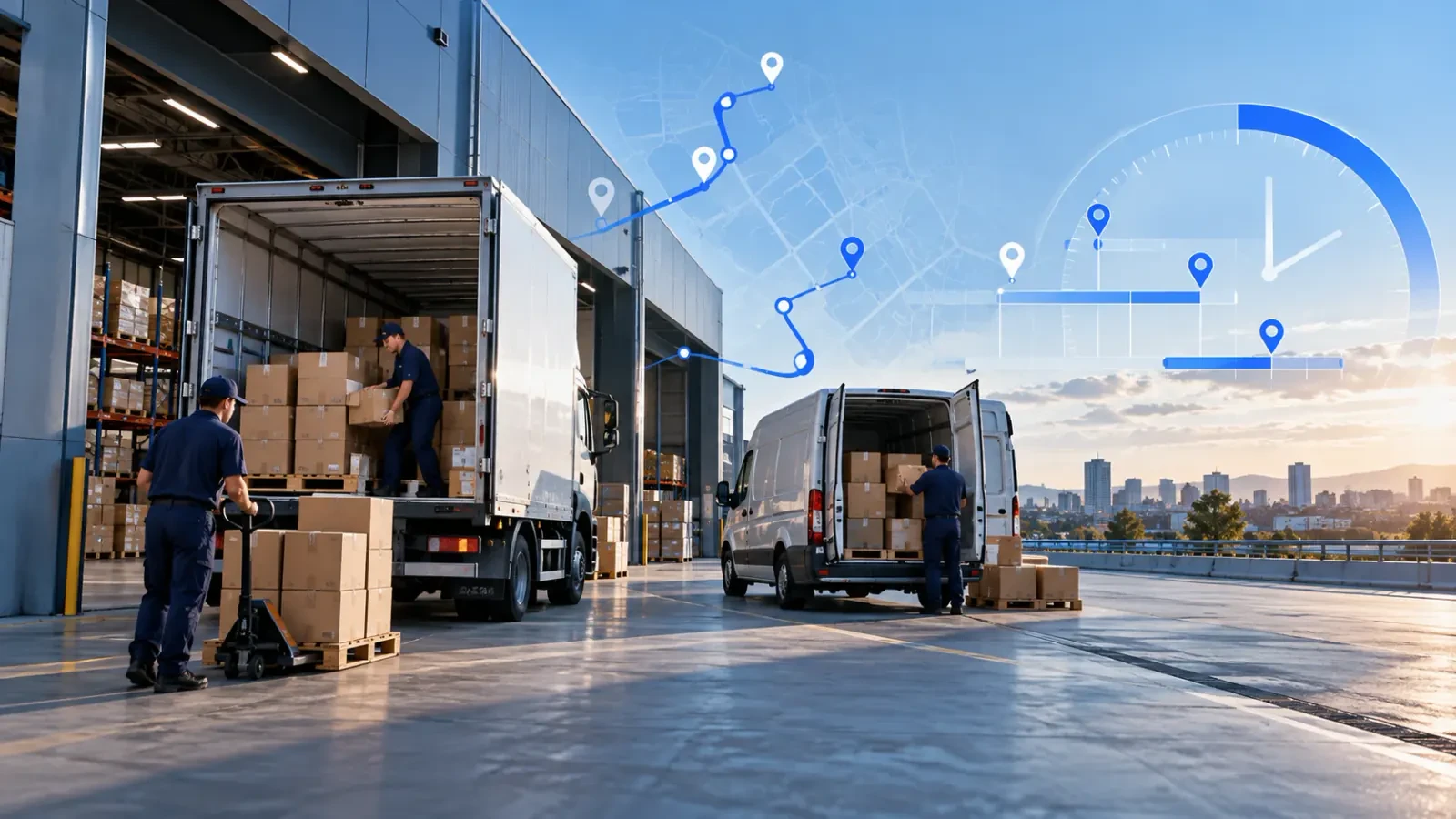
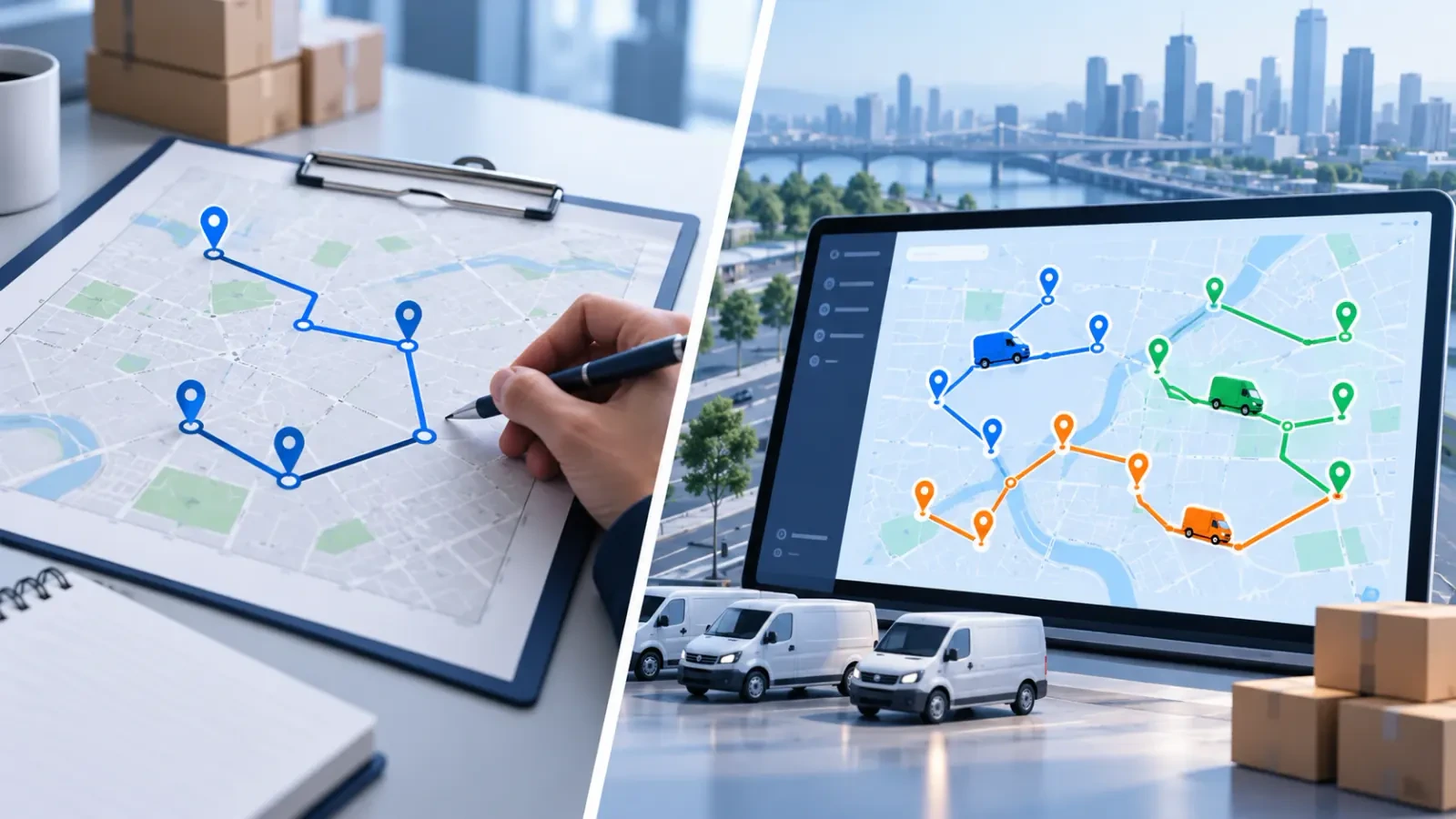
Choosing the right route in a delivery operation is more than connecting delivery points on a map. Which vehicle carries which orders, how long drivers can work, when customers accept deliveries and how much each vehicle can carry all directly affect whether a plan can actually be carried out.
In businesses with many vehicles and delivery points in particular, these decisions depend on one another, which makes planning complex.
Route optimization manages this complexity with mathematical methods. It aims to produce routes and task assignments that fit the operational conditions and are better with respect to the chosen objectives.
So how exactly does route optimization work, and why does it matter for businesses?
What is route optimization?
Route optimization is the process of calculating which points vehicles will visit, in what order, and, where needed, how tasks are divided among vehicles, according to specific objectives and constraints.
These objectives vary with the needs of the business. For example, the aim may be to reduce total travel distance, shorten delivery times, limit the number of vehicles used or lower the total cost of the operation.
However, the shortest route is not always the best route.
A vehicle may cover a shorter distance but arrive before the delivery point accepts goods and wait for a long time. Another route may be slightly longer yet complete the deliveries at suitable times.
For this reason, the core question in route optimization is not just “Which is the shortest path?”
The real question is:
“How can we carry out the tasks better with the resources and operational conditions we have?”
How does route optimization work?
Route optimization consists of several stages that complement one another.
1. Preparing the planning data
First, the data for the operation to be planned is determined.
This can include delivery addresses and locations, order quantities, vehicle characteristics, driver availability, working hours and delivery time windows.
The time needed for loading, unloading or service at each stop also matters.
For example, a vehicle may need 20 minutes to reach a customer and another 15 minutes for the delivery itself. A plan that ignores this time may show later deliveries as earlier than they will really be.
Current and accurate data is important. Wrong addresses, missing service times or vehicle capacities that do not reflect reality can make a plan that looks valid mathematically hard to carry out in the field.
2. Calculating distances and travel times
Once the delivery points are known, the transport relationships between them are built.
Optimization systems can evaluate the distances or estimated travel times between points in a matrix.
This matrix expresses how costly it is, operationally, to go from one point to another.
Two concepts need to be kept apart here:
- Distance: The length of road the vehicle is expected to cover.
- Travel time: The time the vehicle is expected to spend between two points.
These values do not measure the same thing. A shorter route can take longer because of road conditions.
Traffic conditions can also change over time, so it matters which conditions the travel time data represents.
3. Defining operational constraints
A route can be short in theory and still fail to meet the business’s operating rules.
Common constraints include:
- Vehicle capacity: The amount of load a vehicle can carry.
- Delivery time windows: The hours during which a customer can accept a delivery.
- Working hours: The available time defined for a vehicle or driver.
- Resource availability: Whether a particular vehicle or driver can be used for the task.
- Task assignment rules: Some tasks can only be assigned to certain resources.
- Route duration: A route must not exceed a set time limit.
Some of these conditions can be modeled as mandatory, and others as flexible at a certain cost. Which approach is right depends on the business’s real operating rules.
For example, exceeding vehicle capacity may not be allowed, while deviating from the preferred time for a delivery may, in some operations, be evaluated with a penalty cost.
4. Setting the optimization objective
What the system is meant to improve must be defined clearly.
Reducing total distance, reducing total travel time and reducing the number of vehicles used are not the same objective.
For example, using fewer vehicles may require the available vehicles to run longer routes. An assignment that reduces total distance may leave the workload unbalanced between vehicles.
This is why the business’s priorities are reflected in the objective function.
In a good optimization model, it is important not only that the objective value is low but also that the solution makes operational sense.
5. Calculating the routes
After the data, objectives and constraints are defined, the optimization algorithm searches the possible routes and task assignments.
In the literature, a large share of these problems is addressed under the Vehicle Routing Problem (VRP).
VRP is a mathematical optimization problem that studies how vehicles and routes should be organized when several vehicles have to visit certain points.
In practice, different solution methods can be used depending on the size and structure of the problem. They include mathematical optimization techniques, heuristics and metaheuristic algorithms.
These methods try to find good solutions among a very large number of possible plans. For complex and large problems in particular, reaching the mathematically proven best result is not always guaranteed.
6. Evaluating and applying the results
The output of optimization should not be treated as just a drawing of routes.
To judge how usable a plan is, you can look at the tasks assigned to vehicles, stop sequences, estimated arrival times, total distance, capacity use and tasks that could not be served.
After the operations team reviews the plan, it can put it into practice.
Field conditions can change after planning, so comparing planned values with actual results also matters for continuous improvement.
A simple route optimization example
Imagine a delivery business that will serve four customers.
The business has two vehicles, each with a load capacity of 800 kg.
The order quantities are as follows:
| Delivery point | Load |
|---|---|
| A | 300 kg |
| B | 400 kg |
| C | 350 kg |
| D | 250 kg |
| Total | 1,300 kg |
The total load is 1,300 kg, so a single vehicle with an 800 kg capacity cannot carry all the orders in one trip.
A task assignment that is feasible in terms of capacity for the two vehicles could be:
Vehicle 1: A and B — 700 kg in total
Vehicle 2: C and D — 600 kg in total
This assignment meets the capacity condition. But we cannot yet say it is an optimized plan.
That is because customer locations, delivery times, vehicle starting points and travel times have not been taken into account.
For example, if A and D are very close to each other, assigning A and B to the same vehicle may not be a good choice in terms of distance.
The aim of optimization is to evaluate these variables together and determine suitable assignments and visit sequences.
This example is prepared to explain the concept. It is not a real optimization run or a measured performance result.
Main problem types used in route optimization
Route optimization is not a single problem. Different mathematical models are used depending on the needs of the business.
Traveling Salesman Problem (TSP)
The basic problem of the order in which a single vehicle or traveler visits certain points. In its classic form, the goal is to visit every point and minimize the total travel cost.
Vehicle Routing Problem (VRP)
Covers several vehicles sharing tasks and determining their routes. Compared with TSP, dividing tasks among vehicles is also part of the decision.
Capacitated Vehicle Routing Problem (CVRP)
Vehicles have limited load capacity. When tasks are distributed, the load limits of the vehicles must be respected.
Vehicle Routing Problem with Time Windows (VRPTW)
Customer visits or service starts must fall within specific time intervals.
For example, if a customer accepts deliveries only between 09:00 and 11:00, the route must take this condition into account.
In real operations, several constraints such as capacity and time windows can exist in the same model.
What can route optimization offer businesses?
A well-defined route optimization process can help businesses in several ways.
More effective use of resources: The distribution of tasks among vehicles and drivers can be evaluated more systematically.
A standardized planning process: Planning decisions can be supported by defined business rules instead of relying only on personal experience.
Control over distances and costs: The aim can be to reduce unnecessary travel. However, the financial result also depends on vehicle costs, labor and other operating expenses as well as fuel consumption.
Compliance with time constraints: Delivery acceptance hours and working time limits can be taken into account already at the planning stage.
Comparing decisions: The results of different resource, capacity or timing scenarios can be examined.
The size of these benefits varies from business to business. So promising a specific percentage of savings without a verified comparison is not appropriate.
What to look for when choosing route optimization software
When evaluating route optimization software, it is not enough to look at how the routes appear on a map.
First, check whether the system supports the business’s real constraints.
The needs of a business with many delivery points may differ from those of a business that runs fixed routes with a few vehicles.
You should also assess how the plans are reviewed, how much control users have over the results, how data is imported into the system and how the plan turns into field operations.
To understand the software’s performance, test it where possible with representative data sets that resemble real operations.
Look not only at total kilometers but also at how well the plan respects the constraints and at the operation as a whole.
How does Trackinia approach route optimization?
Trackinia is a logistics operations management platform that handles route optimization together with vehicle and driver planning.
It focuses on evaluating conditions such as vehicle capacities, delivery time windows, resource availability, working hours and planning days together.
In daily and multi-day planning scenarios, the aim is to assign tasks to suitable vehicles, drivers and days.
Plans can be reviewed on a map and a timeline. The goal is for the optimization result to be more than a numerical output, a plan that operations teams can evaluate.
To assess how well Trackinia fits your operation, you can have a demo session based on your delivery volume, number of resources and business rules.
Conclusion
Route optimization is not only about finding the shortest route. It is about planning delivery tasks better under the available vehicles, drivers and operational constraints.
A successful implementation needs accurate data, realistic constraints, clearly defined objectives and results that can be carried out in the field.
For this reason, route optimization should be seen not as a stand-alone map feature but as one of the important decision-support tools of logistics planning.