
MULTI-STOP DISTRIBUTION
Manage many deliveries as parts of a single plan.
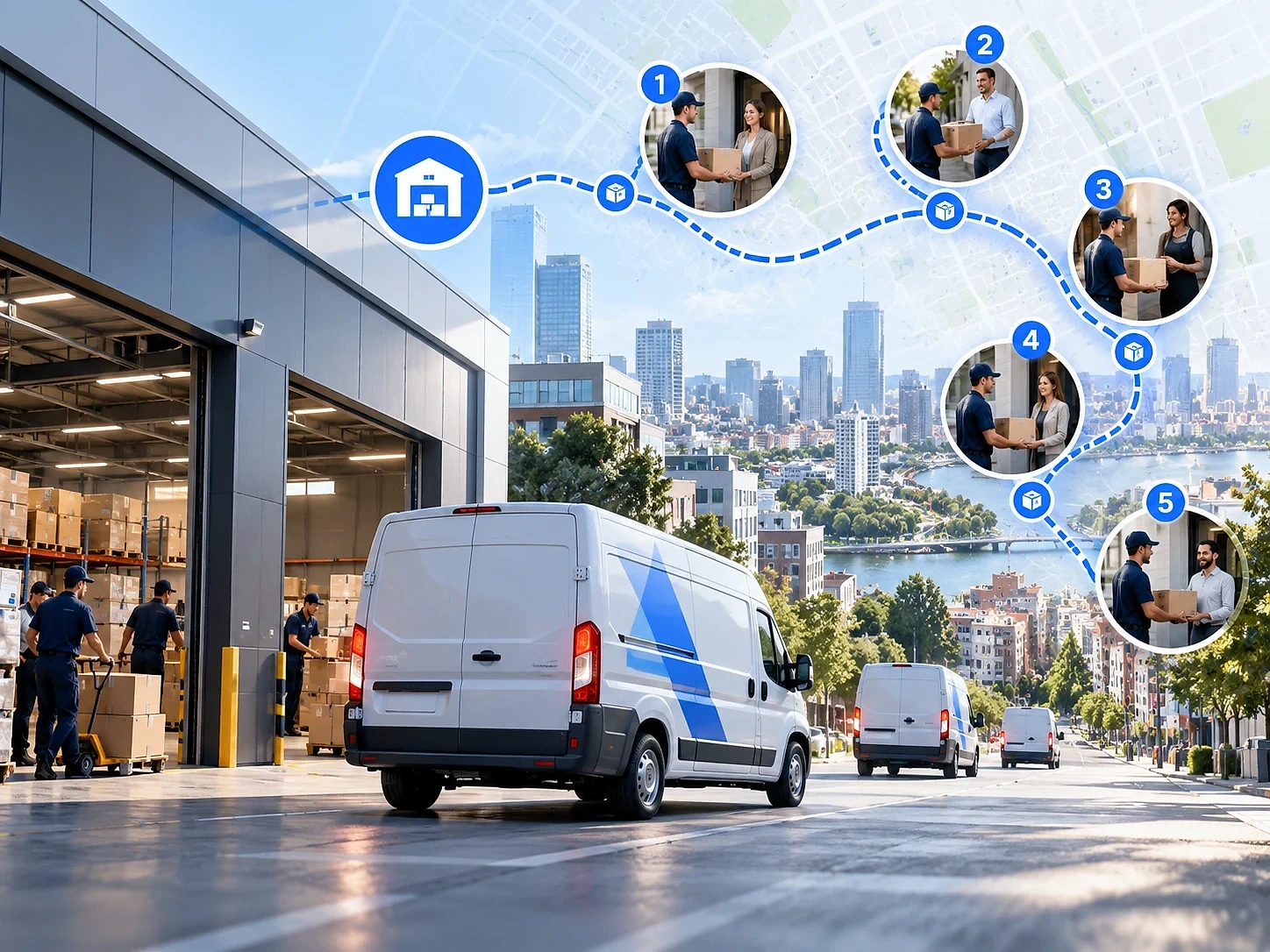
Plan a large number of delivery points together with vehicle capacity, delivery times and operational rules. Assign tasks to suitable vehicles, optimize the stop sequence and review the routes on one screen.
CHALLENGES
Why does planning get harder as delivery points grow?
- 1
A growing number of delivery points
As deliveries increase, assigning tasks to vehicles and deciding the visit order becomes more complex.
- 2
Delivery conditions that affect each other
Geographic proximity is not enough. Vehicle capacity, customer receiving hours and service times must be considered as well.
- 3
Checking the planning result
It is not enough to generate routes; the operations team also needs to be able to review them.
HOW TRACKINIA HELPS
How does Trackinia plan multi-stop distribution?
Orders are prepared for planning
Orders and delivery points are imported from Excel or CSV, or created in the panel.
Vehicles and drivers are selected
You choose the vehicles and drivers that take part in the plan. Depot start and end points can be defined.
Operational rules are applied
Vehicle capacity, delivery time windows and service durations are taken into account in the calculation.
Routes and task assignments are optimized
Tasks are assigned to suitable vehicles and each vehicle gets a stop sequence. The goal is a feasible, efficient plan that respects your rules.
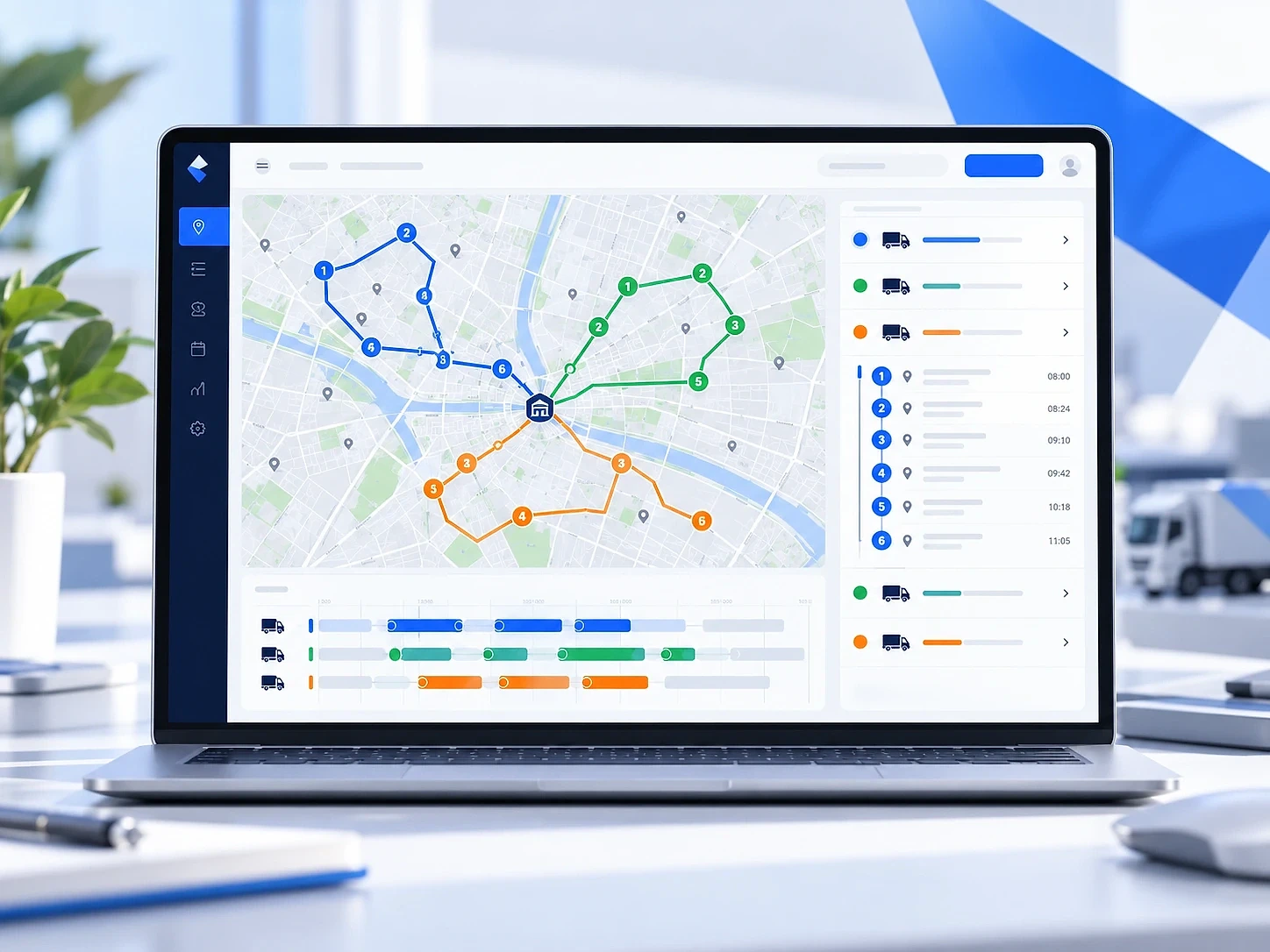
Results are reviewed on the map and timeline
You review routes and stop sequences, then publish the plan when you are satisfied with it.
IN DETAIL
The problem behind multi-stop route planning
Even for a single vehicle, stop sequencing grows explosively: 10 stops mean 10! = 3,628,800 possible orders and 15 stops mean 15! = 1,307,674,368,000. With several vehicles, which stop goes to which vehicle must also be decided. This whole is known in the literature as the vehicle routing problem (VRP).
Problems of this size are solved with heuristic and metaheuristic methods rather than by trying every order; the aim is a good plan in reasonable time. A short route is not the same as a feasible route: capacities and time windows shape the sequence directly.
Mathematical optimizationHow does this work in Trackinia?
- 1
Planning input
Orders are imported from Excel or CSV or created in the panel. You choose the vehicles, drivers and depot start and end points that take part in the plan.
- 2
Planning output
Each route gets a stop sequence, a planned timeline (driving, service, waiting, breaks), distance, duration, capacity utilization and cost items.
- 3
Stops and activities
A continuous stay at one location is a single stop; a stop can contain several activities (delivery, pickup, service), each tracked as separate work.
- 4
Result status
A result is marked optimal, feasible, feasible within the time limit or infeasible. Unplanned tasks are listed with their reasons.
- 5
Publishing
A calculated plan is a proposal; it is not active until you publish it. Once published, routes reach the drivers.
Scope and limits
- Optimization currently minimizes cost; additional objectives such as balanced workload are not supported.
- A result is not guaranteed to be the best possible; proving that is impractical for large problems.
- Inventory management, 3D loading and in-vehicle layout are not planned.
EXAMPLE SCENARIO
A regional distributor’s daily delivery run
A distributor delivers to dozens of points on the same day with several vehicles. Customers receive goods at different hours, and the vehicles do not all have the same capacity.
Illustrative example: this scenario shows how the product can be used. It is not a customer case or a measured result.
- 1
The day’s orders are imported and the delivery points appear on the map.
- 2
The vehicles and drivers that take part in the plan are selected.
- 3
Routes are calculated with capacity, delivery times and service durations applied.
- 4
The operations team reviews the routes on the map and timeline and publishes the plan.
Frequently asked questions
What is multi-stop route optimization?
It decides together which vehicle visits which delivery points and in what order. The aim is an efficient plan that respects conditions such as capacity and delivery times.
What determines the delivery sequence?
Besides locations, the calculation considers vehicle capacity, customer time windows, service durations and driver working rules.
Can vehicles with different capacities be planned together?
Yes. Vehicles can be defined with different capacities and features, and the calculation assigns each task to a suitable vehicle.
Does the calculation guarantee the best possible result?
No. For realistically sized routing problems, proving the best solution is usually not possible. The calculation searches for a good plan that fits your constraints and shows the status of the result separately.
What happens if an order cannot be planned?
The calculation leaves that task out of the plan and lists the reason. You can change constraints (for example a time window or the vehicle pool) and recalculate.